Zhurov Method / Guide
The phases of ejaculation: emission, expulsion, and the management window
A simple explanation of the two phases of ejaculation - emission and expulsion - and where the moment still exists when management is possible. The physiology of PONR in plain language.
Updated:
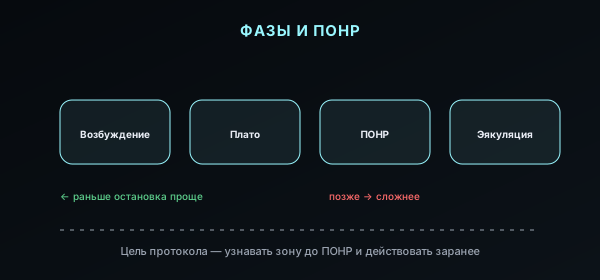
Ejaculation is not one instant switch. It is a sequential process in two phases, and between them lies the Point of No Return - PONR. You need to understand these phases not for an anatomy exam, but for one practical reason: to know exactly where the management window exists and where it is already too late. Until a man understands this, he either tries to manage where it is no longer possible, or he misses the moment when action could still change the outcome.
In short
- ✓Emission is the first phase: semen gathers in the urethra and pressure builds. There is still a management window here.
- ✓Expulsion is the second phase: rhythmic muscle contractions and ejaculation. Stopping is impossible here - it is a spinal reflex.
- ✓PONR is the boundary between the phases. The task is to learn to act during emission, before PONR.
- ✓The signs that emission is beginning include internal pressure, the feeling of "almost there," and faster breathing. That is not the finish - it is a warning.
Phase 1. Emission: when you still can
In the emission phase, the seminal vesicles and prostate begin to contract. Semen mixes with prostatic fluid and moves into the back part of the urethra. Pressure builds there - that familiar sense of "almost there," "it is about to happen," pressure inside or low in the belly.
This is still not PONR. It is a warning. During emission, a man still has a few seconds in which a change of state - breathing, relaxation, lowering the pace - can change the outcome. Not guaranteed, not always, but possible. This is exactly where the skill works.
The key signal of emission to learn is the feeling of pressure and fullness around the prostate area, the growing sharpness of sensation, the urge to suddenly speed up, or the feeling that "it is about to go on its own." This is not PONR - it is still before it.
Phase 2. Expulsion: when you cannot
Expulsion is the rhythmic contraction of the pelvic floor muscles that pushes semen out of the urethra. This is a spinal reflex: it is controlled directly by the spinal cord, without conscious control. Once expulsion begins, you cannot stop the process through willpower.
That is why all attempts to "hold on" in the very last moment so often fail: the man is trying to apply control already in the expulsion phase, when the management window is closed. That is not weak will. That is physiology.
Accepting the expulsion phase as natural is also part of the work. Not every training session ends with a "successful hold." OM is observation and learning, not competition. Expulsion is not failure. It is data.
Where PONR is, and how to find it
PONR - the Point of No Return - sits exactly on the boundary between emission and expulsion. Physiologically, it is the moment when contractions of the pelvic floor muscles become involuntary and rhythmic. Before that, management is still possible. After that, the reflex is already underway.
Subjectively, PONR is often described as the moment of "that's it, it has gone" or "I can't stop it now." Before it, there is still some sense of choice, even if barely. This contrast is exactly what you need to learn to notice.
In OM with attention, a man gradually begins to distinguish: this is emission - pressure is rising, sensations are sharp, but still manageable. This is PONR - the feeling that "it has started." That distinction is the skill.
How to use this knowledge of the phases in practice
Understanding the two phases changes the task. It is no longer "how not to finish," but "how to act during emission while PONR has not arrived yet." That is a concrete and solvable task.
At the moment when signs of emission appear - pressure, rising sharpness, the urge to speed up - that is the signal to act: exhale, relax the three zones - belly, pelvis, glutes - lower the pace, or pause. Not a fight with the finish, but a change in temperature and leak in the Bottle before PONR.
Over time, through regular OM, the recognition boundary moves back: a man begins to notice the start of emission earlier and earlier. Which means more time for management. That is exactly what expanding the management window means.
First step for 7 days
- •After practice, write down whether there was a moment when the body had already "decided to finish," and what was happening 10-20 seconds before it.
- •In your next OM, try to distinguish two sensations: "pressure is beginning" - emission, and "it has already started" - PONR. These are different things.
- •When pressure and sharpness appear, exhale, relax the belly and pelvis, and do not speed up. See what changes after 15 seconds.
- •Do not get discouraged if PONR arrived earlier than you expected. Write down the observation and use it as data for the next training session.
Common questions
Why can't I feel the difference between the phases?
Because your attention has not been directed there before. Recognizing the phases is a trainable skill. Through 2-3 weeks of regular OM with attention, most men begin to tell them apart more and more clearly.
Can expulsion be stopped?
No. Once expulsion begins, it is a spinal reflex. The task is not to stop it, but to act before it, in the emission phase.
What does "management window" mean?
It is the period during emission when changing the breath, relaxation, and pace can still change the outcome. Through training, this window expands: a man begins to notice the start of emission earlier.
Is this medical treatment?
No. Important point: Zhurov Method is an educational system for skill training, not medical treatment. We do not replace doctors. If you have acute physical pain, inflammation, or other medical symptoms, start with a urologist. That is a normal adult step for a man, and we can train attention and relaxation in parallel.